aimez is the working home for a cross-domain research program using Manhattan as a model system for how stress patterns organize in a city. The program treats high- and low-pressure areas, routing behavior, and corridor response as measurable and documentable.
Why this work is timely
The current problem is how local pressure becomes organized behavior in a modeled system. In the Manhattan substrate, camera-derived stress and public capacity layers make pressure patterns visible on a pedestrian graph, then routing algorithms reveal how movement changes across that topology.
Current demonstrated substrate
The Manhattan pedestrian-routing substrate is the first applied instance of this research direction. It pairs a camera-derived stress field with a public-data capacity model and shows how routing changes when algorithms move through the stress topology of the city rather than distance alone.
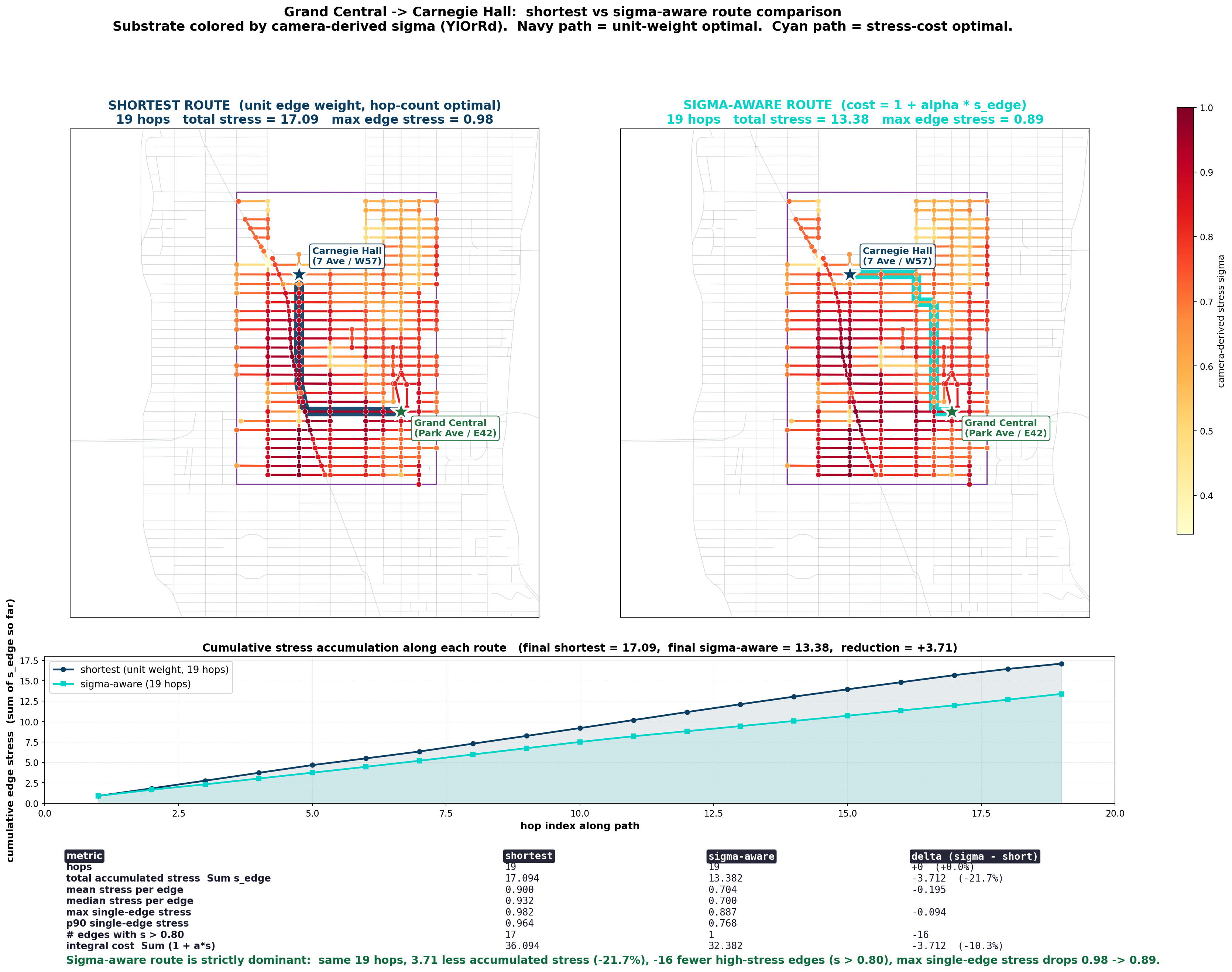
Shortest versus stress-aware routing. Same origin, same destination, same hop count, different accumulated stress and different edge exposure. This is the substrate's clearest demonstration of routing behavior changing over a measured stress topology.
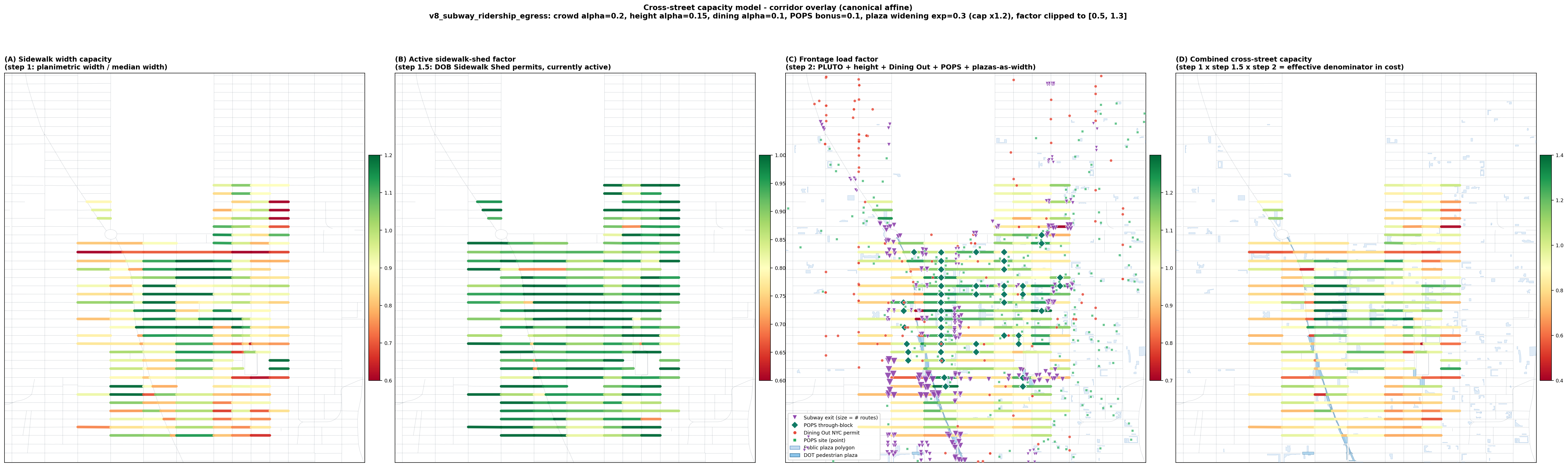
Corridor-level constraint field. Sidewalk width, active sheds, frontage load, and the combined capacity factor rendered as measured per-block fields.
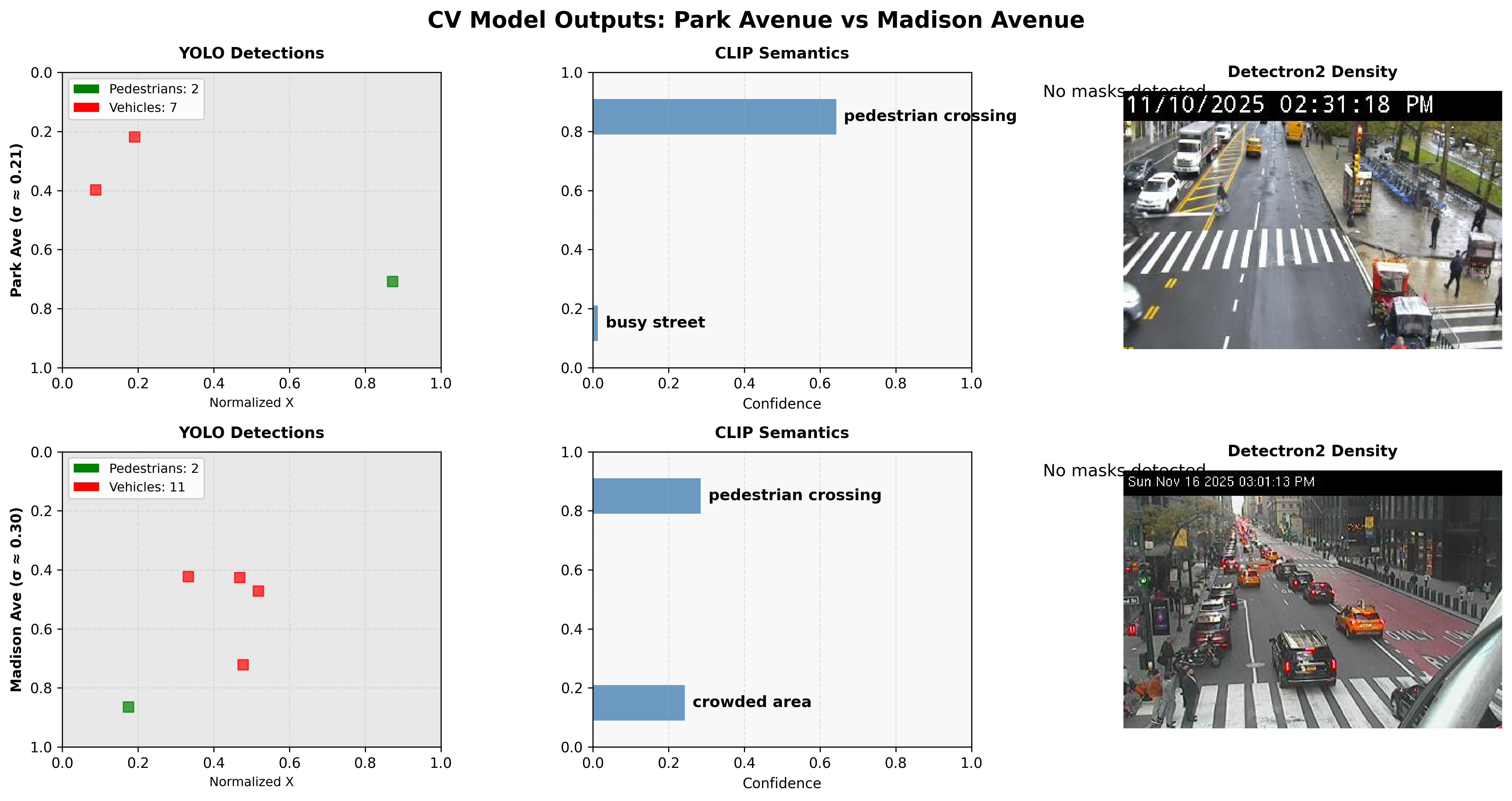
Demand-side measurement. Computer vision outputs comparing low-stress and high-stress corridor cameras. The program's demand-side signal is grounded in observable city conditions.
Philosophical and methodological direction
The program's current language is grounded in modeled fields, stress topology, and emergent organization. Three external anchors sharpen that direction: attractor-level analysis from the Sharpness Dimension / Edge-of-Stability literature, world-anchored representation from Allocentric Flocking, and the broader active-matter / crowd-dynamics lineage that treats non-local system response as a structural property rather than a local rule.
One external language that helps orient the direction of the program is structured temporal intelligence: systems that remain responsive to uncertainty, context, memory, and world-anchored structure rather than optimizing inside a closed prompt field. This is a future-facing alignment concept, not a public identity term.
Where the work can go
research papers that formalize the structural problem more rigorously
modeled systems in additional domains where local pressures and organized response can be measured
collaborations on collective behavior, navigation, modeled environments, and experimental AI engineering
grant-facing packets and program overviews that can show the same structural problem at multiple scales
 aimez
aimez